

Updated November 2026 · Anna Omni, art & fashion photographer and visual creator
The short version: medium format gives you more resolution, more room to crop and retouch, and smoother tonal transitions. It does not automatically give you a shallower depth of field or a better picture. Full frame is faster, lighter, has far more lenses, and is enough for most fashion, portrait and beauty work.
This guide compares the two formats in numbers, lists the current systems, and ends with a checklist. No prices here, because they change every month.
Sensor sizes: what “medium format” means today
“Medium format” covers two different sensor sizes. The difference matters.
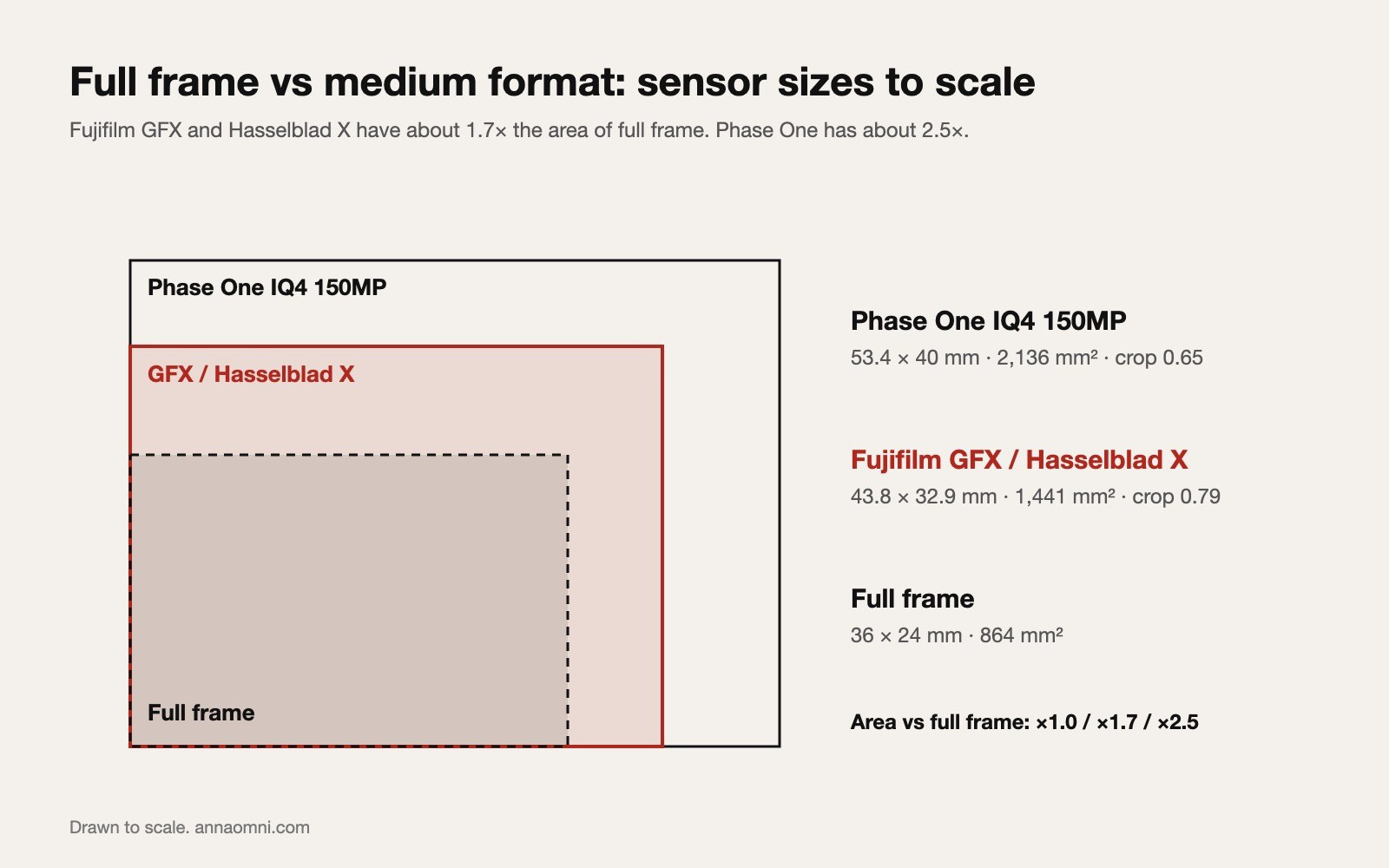
- Full frame: 36 × 24 mm, about 864 mm². Aspect ratio 3:2.
- “Small” medium format: 43.8 × 32.9 mm, about 1,441 mm². Aspect ratio 4:3. This is the sensor in Fujifilm GFX and Hasselblad X cameras. It has about 1.7 times the area of full frame.
- “Full frame” medium format: 53.4 × 40 mm, about 2,136 mm². This is the sensor in the Phase One IQ4 150MP digital back. It has about 2.5 times the area of full frame.
Most photographers who say “medium format” in 2026 mean the middle one. It is a smaller step up than the name suggests: the long side is only about 22% wider than full frame.
The 4:3 shape is a quiet advantage. It is closer to a magazine page and to a 4:5 social post than 3:2 is, so you crop away less of the frame in vertical work.
Crop factor: converting focal length and aperture
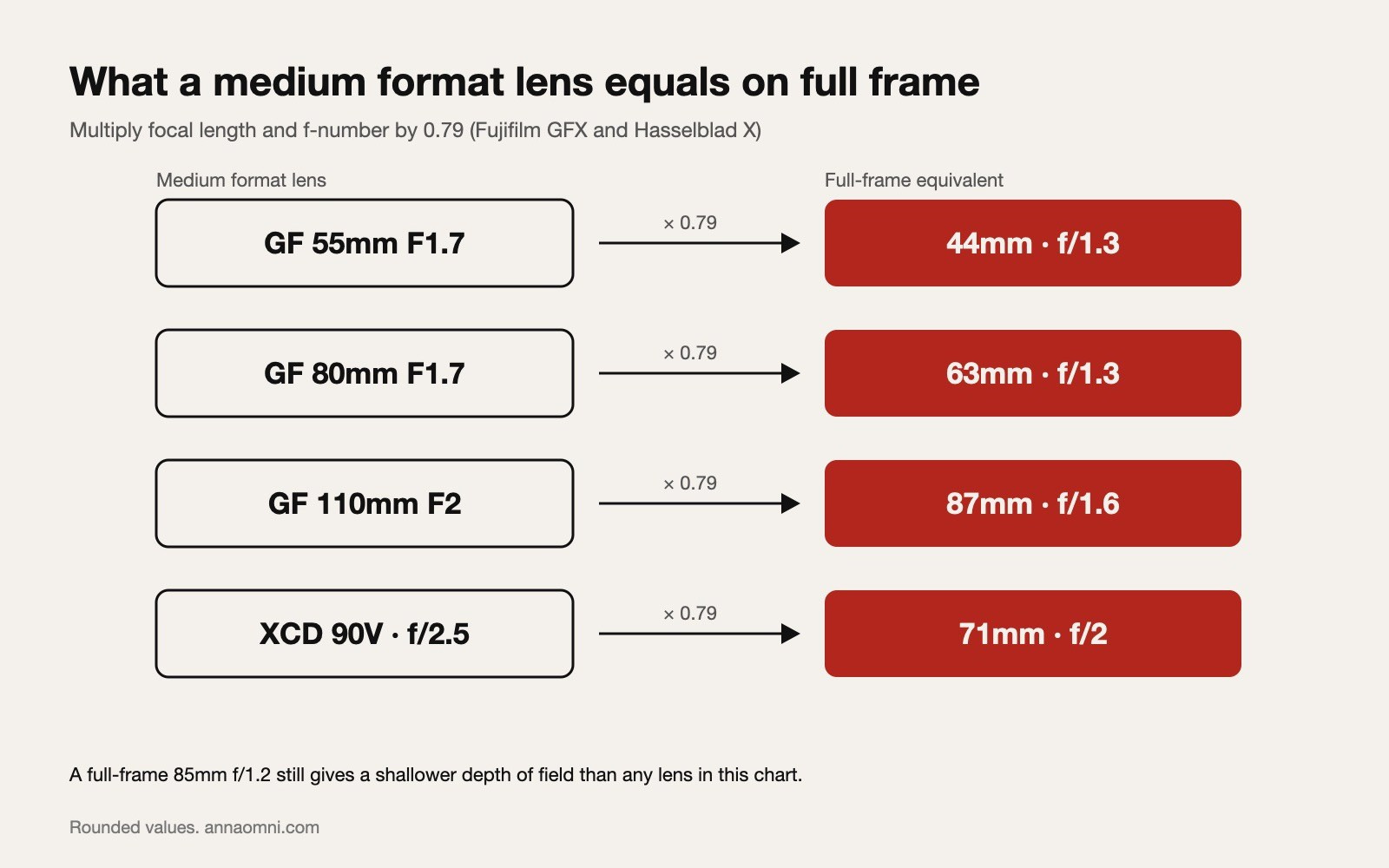
The crop factor of the 43.8 × 32.9 mm sensor is about 0.79. Multiply the focal length by 0.79 to get the full-frame equivalent. To compare depth of field, multiply the f-number by 0.79 as well.
- Fujifilm GF 55mm F1.7 R WR: frames like a 44mm lens, with the depth of field of about f/1.3 on full frame.
- Fujifilm GF 80mm F1.7 R WR: frames like 63mm, depth of field of about f/1.3.
- Fujifilm GF 110mm F2 R LM WR: frames like 87mm, depth of field of about f/1.6. This is the classic GFX portrait lens.
- Hasselblad XCD 90V (f/2.5): frames like 71mm, depth of field of about f/2.
The Phase One sensor has a crop factor of about 0.65, so an 80mm lens there frames like a 52mm on full frame.
For help choosing focal lengths for each type of shot, see best lenses for fashion photography.
Medium format vs full frame depth of field
This is the most common misunderstanding. A bigger sensor does give a shallower depth of field at the same framing and the same f-number. But full-frame lenses are faster, and that cancels the advantage.
Compare two portrait set-ups:
- Fujifilm GF 110mm F2 R LM WR on a GFX body: equivalent to about 87mm f/1.6.
- Canon RF 85mm F1.2L USM or NIKKOR Z 85mm f/1.2 S on full frame: 85mm f/1.2.
The full-frame lens gives the shallower depth of field. An 85mm f/1.4, such as the Sony FE 85mm F1.4 GM II, lands very close to the medium format result.
In the studio the question disappears. With flash you usually work between f/8 and f/11 to keep the whole outfit sharp, and both formats give plenty of depth.
If shallow depth of field is your main reason to switch, stay on full frame and buy a faster lens.
What medium format really gives you
Resolution and room to crop
Current Fujifilm GFX bodies record 102 megapixels: 11,648 × 8,736 pixels. At 300 pixels per inch that is a print of about 99 × 74 cm without upscaling.
Full frame has moved closer. The Sony Alpha 7R VI, announced in May 2026, has about 66.8 megapixels. Against a sensor like that, 102 megapixels gives roughly 24% more detail along each side. Against a 45-megapixel body the gain is about 50%.
More pixels mean you can:
- cut a vertical cover, a horizontal spread and a detail crop from one frame;
- retouch skin and fabric at a finer scale;
- print large for retail displays, exhibitions and billboards viewed up close.
Tonal transitions and colour
This is the part people call the “medium format look”. Gradients from light to shadow on skin look smoother. Highlights on satin, leather and metal roll off more gently. Files hold up better under heavy colour grading.
Two things are behind it. A larger sensor collects more total light at the same exposure, which lowers noise in the mid-tones and shadows. And these cameras offer 16-bit raw files: Fujifilm’s GFX100 II and GFX100S II both list 14-bit and 16-bit RAW, and Hasselblad lists 16-bit colour and 15.3 stops of dynamic range for the X2D II 100 °C. That figure is the maker’s own, measured its own way, so don’t compare it directly with numbers from other brands.
The gain shows in large prints and in files pushed hard in post-production. On a phone screen it does not.
Flash sync with leaf shutter lenses
Hasselblad XCD lenses have a leaf shutter inside the lens. It syncs with flash at every shutter speed. The top speed depends on the lens: 1/2000 s on lenses such as the XCD 55V, and 1/4000 s on the XCD 25V and XCD 90V.
Outdoors this lets you darken a bright sky at a wide aperture and still light the model, without high-speed sync and its loss of power.
Fujifilm GFX bodies use a focal-plane shutter. The GFX100 II and GFX100S II sync at 1/125 s or slower. Most full-frame cameras sync faster, so this advantage belongs to Hasselblad only.
What medium format does not give you
- A better picture by default. Light, styling, casting and direction decide a fashion image. The sensor does not.
- Automatically shallower depth of field. See the comparison above.
- Visible gains on small screens. Instagram and web shops downscale everything to a couple of thousand pixels.
The downsides
Weight and size
Bodies are no longer the problem. The Fujifilm GFX100S II weighs about 883 g with battery and card, close to a professional full-frame body. The lenses are the weight: the GF 110mm F2 is about 1,010 g.
Autofocus and burst speed
The Hasselblad X2D II 100 °C added continuous autofocus with subject tracking, which works with compatible XCD lenses. The Fujifilm GFX100 II shoots at about 8 frames per second with the mechanical shutter, and the GFX100S II at about 7.
Compare that with the 30 frames per second of the Sony Alpha 7R VI. For a model walking or jumping, full frame gives you more sharp frames to choose from.
Lens choice
Fujifilm lists around twenty GF lenses, including tilt-shift and cinema zooms. Hasselblad’s XCD range is smaller. Full-frame mounts have several times more, plus third-party options at every budget. There is no f/1.2 portrait lens and no direct match for a 70-200mm f/2.8.
File size and computer load
A 102-megapixel file holds more than four times the pixels of a 24-megapixel file. A 16-bit raw is larger again. Expect slower tethering and previews, bigger cards and more backup storage. Check that your computer and raw converter handle the camera before you commit.
Do you need medium format for fashion? Who it suits
Medium format makes sense when the final use demands it:
- Advertising campaigns and large prints: billboards, in-store displays, exhibition prints.
- Beauty and cosmetics: tight crops on skin, lips and eyes, with heavy retouching.
- Jewellery, watches and fabric detail: texture is the product.
- Editorial with unknown layouts: one frame has to work as a cover, a spread and a crop.
- Slow, controlled studio work: tripod, tether, a few carefully built frames per look.
Who should stay on full frame
- Social media and web content. The extra resolution is thrown away on export.
- E-commerce and lookbooks. Hundreds of frames a day. Speed and small files matter more.
- Runway and backstage. You need fast tracking autofocus, long zooms and high burst rates.
- Travel and location work with a small team. Every kilo counts.
- Anyone building a first kit. Lights, modifiers and lenses improve pictures more than a bigger sensor.
Current medium format systems (November 2026)
Fujifilm GFX
- Fujifilm GFX100 II: the flagship. 102 megapixels, about 8 frames per second, about 1,030 g with viewfinder.
- Fujifilm GFX100S II: the same resolution in a smaller body, about 883 g. The usual entry point for portrait and fashion work.
- Fujifilm GFX100RF: a fixed-lens compact with a wide lens. More a travel and documentary camera than a fashion tool.
Hasselblad X
- Hasselblad X2D II 100 °C: 100 megapixels, 16-bit colour, continuous autofocus, in-body stabilisation and a built-in 1TB SSD. Leaf shutter lenses give flash sync at all speeds.
- Hasselblad 907X & CFV 100 °C: a 100-megapixel digital back on a very small body, about 620 g. It also fits classic V System film cameras.
Phase One
- Phase One XF IQ4 150MP: the larger 53.4 × 40 mm sensor, 16-bit raw files and a modular body. It is a specialist studio tool, normally rented with a digital technician for big advertising productions.
Rent before you buy
Most professional rental houses stock GFX and Hasselblad X kits, and Phase One systems for larger productions.
Renting makes sense when:
- only a few jobs a year need the resolution;
- the client’s budget covers equipment hire;
- you want to test the workflow before buying.
Rent a day early before an important shoot. Test tethering, autofocus on a moving model, and how your computer handles the files.
Checklist: medium format or full frame?
Choose medium format if:
- your work is printed large or cropped hard;
- you shoot beauty, jewellery or campaigns with heavy retouching;
- you work slowly, on a tripod or tethered;
- you want leaf shutter flash sync outdoors (Hasselblad);
- your computer and storage can handle 100-megapixel files;
- your lighting is already good.
Stay on full frame if:
- most of your work ends up on screens;
- you shoot movement, shows or many looks per day;
- you want the shallowest depth of field for the least money and weight;
- you travel light or work alone;
- you would have to cut your lighting or lens budget to afford the bigger sensor.
FAQ
Is medium format better than full frame for portraits? It gives more resolution and smoother tones for large prints and detailed retouching. For portraits shown on screens, full frame is equal in practice and faster to use.
Does medium format have a shallower depth of field? At the same f-number and framing, yes, by about two-thirds of a stop on the 43.8 × 32.9 mm sensor. But full-frame f/1.2 and f/1.4 lenses match or beat the fastest medium format lenses.
What is the “medium format look”? Smooth tonal transitions, clean colour, fine detail and the 4:3 frame shape. Lighting still does most of the work.
What is the crop factor of Fujifilm GFX and Hasselblad X? About 0.79. A 110mm lens frames like an 87mm on full frame, and f/2 gives the depth of field of about f/1.6.
Do I need medium format for fashion photography? No. Full frame is the standard for most editorial and commercial fashion. Medium format is worth it for campaigns, beauty and large prints, and it can be rented for those jobs.
Is 100 megapixels too much? For social media and e-commerce, yes: you only get larger files and slower editing. For big prints and deep crops, it is exactly what you pay for.
Specifications were checked against manufacturers' pages in November 2026. Camera line-ups change; confirm the current version before you buy or rent.
Want help choosing a system or planning a shoot? See mentorship or book a consultation.