

Updated November 2026 · Anna Omni, art & fashion photographer and visual creator
The short version: a 24-70mm f/2.8 zoom covers most fashion work, an 85mm prime is the classic choice for portraits and three-quarter shots, and a 50mm saves you when the studio is small. Everything else is a refinement of those three.
This guide explains why, shows how much room each focal length needs, and lists current mirrorless lenses for Sony, Canon, Nikon and medium format. No prices here, because they change every month; check them on the day you buy.
The short answer: which lens for which fashion shot
- Full-length, studio: 50mm, or 70mm on a zoom. Natural proportions without needing a huge room.
- Full-length, location editorial: 35mm or 50mm. Keeps the place in the picture.
- Three-quarter and portrait: 85mm. Flattering distance, easy background control.
- Beauty close-up: 100–135mm, often a macro. Tight framing from a comfortable distance.
- Details (jewellery, fabric, make-up): 90–105mm macro. Focuses close enough to fill the frame.
- Runway and backstage: 70-200mm f/2.8. You can’t choose where you stand.
All focal lengths are for full-frame cameras.
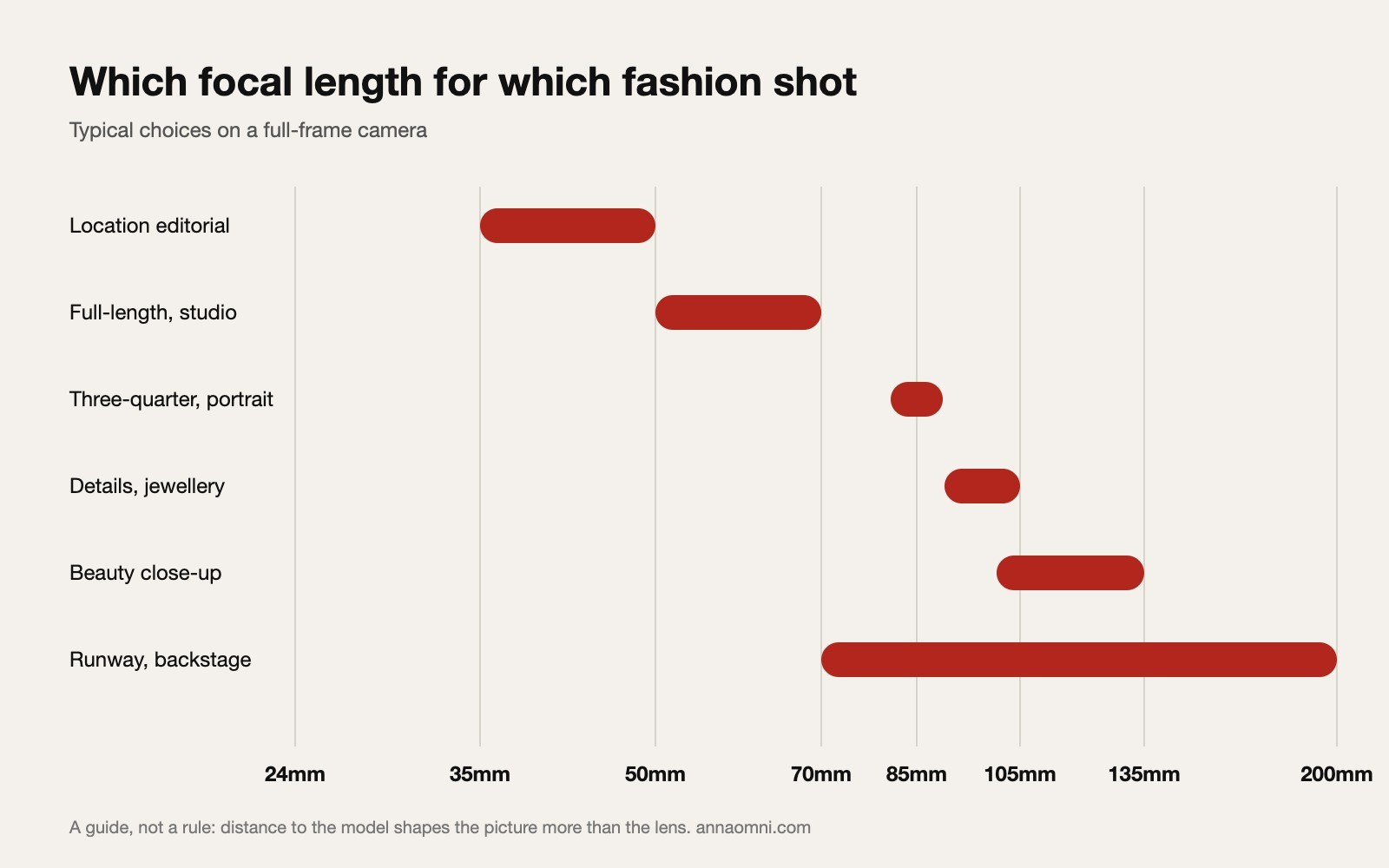
How focal length changes a fashion image
It’s the distance, not the lens
A common claim is that wide lenses distort faces and long lenses flatter them. That is only half true. Perspective depends on how far you stand from the model, not on the lens. A long lens forces you to step back, and the distance is what makes a nose look smaller and legs look more even. Stand in the same spot with a 35mm and an 85mm, crop the 35mm frame, and the proportions match.
So the real question is: how far away do you want to be, and how far away can you be?
Working distance: how much studio do you need
These are approximate distances from camera to model for a vertical full-frame shot. They are calculated, not measured, so treat them as a guide. Add at least a metre behind the model for the background.
- Full-length with some air (about 2.3 m of frame height): 35mm — 2.2 m · 50mm — 3.2 m · 85mm — 5.4 m · 135mm — 8.6 m
- Three-quarter (about 1.3 m): 35mm — 1.3 m · 50mm — 1.8 m · 85mm — 3.1 m · 135mm — 4.9 m
- Head and shoulders (about 0.6 m): 50mm — 0.8 m · 85mm — 1.4 m · 135mm — 2.3 m
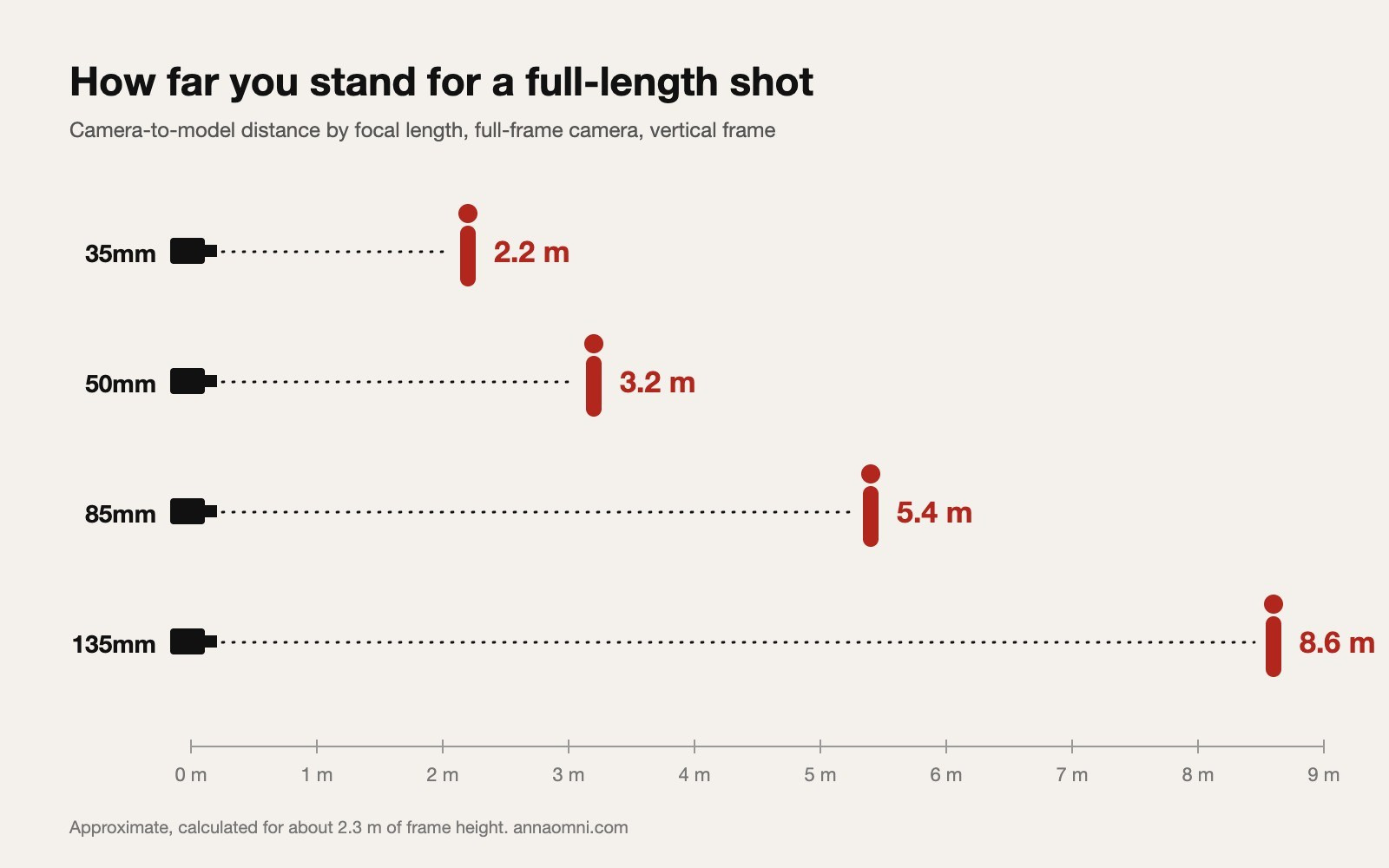
This is why an 85mm, the lens everyone recommends first, is frustrating in a small studio: a full-length shot needs more than five metres of clear floor. In a typical rented room, 50mm is the honest full-length lens.
Background and depth of field
A longer lens shows a narrower slice of the background. On location that is useful: an 85mm or 135mm lets you pick a clean patch of wall and ignore the mess next to it. A 35mm shows everything, so the place has to be worth showing.
Blur follows the same logic. Long lens, wide aperture and a distant background give the softest result. In the studio, on a paper roll, none of that matters much.
Why fashion often goes wider than portrait
A portrait is about a face. A fashion image is about clothes, a body and often a place. That is why editorial photographers use 35mm and 50mm far more than classic portrait advice suggests. Shooting slightly from below with a 35mm makes legs longer and the figure more dominant. It is a deliberate use of perspective, and it only fails when you get too close to the face.
The focal lengths fashion photographers actually use
24-70mm f/2.8: the working zoom
If you can own one lens, this is it. It goes from environmental wide shots to a tight three-quarter without swapping lenses while a whole team waits. Lookbooks and e-commerce are shot on this range almost by default.
35mm: editorial and environment
For stories where the location is part of the picture: streets, interiors, cars, landscapes. Keep the model away from the edges of the frame and keep your distance for close-ups.
50mm: full-length in small spaces
Neutral, light and usually the cheapest fast lens in any system. It is the practical choice for full-length studio shots when you have three to four metres to work with.
85mm: portraits and three-quarter shots
The classic. Comfortable distance for talking to the model, clean backgrounds, flattering proportions. Outdoors it also works for full-length shots if you have the space.
100–135mm: beauty and compression
Beauty work needs a tight frame without putting the camera in the model’s face. A 100mm macro is the standard tool because it also focuses close enough for lips, eyes and jewellery. A 135mm gives the smoothest backgrounds on location, but you will be shouting directions from nearly nine metres away for a full-length shot.
70-200mm f/2.8: runway and location
On a runway your position is fixed, so you need the zoom. On location it gives strong background compression. In a studio it is rarely needed.
Best lenses for fashion photography by system
These are current mirrorless lenses, grouped by job. For each system there is a professional pick and, where it exists, a lighter and cheaper one. This is a selection by specifications and intended use, not a lab test. Weights are from manufacturers' data.
Sony E-mount
- FE 24-70mm F2.8 GM II — the working zoom. One lens for lookbooks, e-commerce and fast commercial days.
- FE 35mm F1.4 GM — location editorials where the place matters.
- FE 50mm F1.2 GM — full-length shots in smaller studios, and natural light at dusk.
- FE 85mm F1.4 GM II — the portrait and three-quarter lens, about 642 g.
- FE 100mm F2.8 Macro GM OSS — beauty close-ups, jewellery and make-up details.
- FE 135mm F1.8 GM — maximum background compression on location.
- Budget picks: FE 85mm F1.8 and FE 50mm F1.8. With studio flash at f/8 the difference from the G Master versions is small.
Canon RF
- RF 24-70mm F2.8L IS USM — the working zoom, about 900 g.
- RF 35mm F1.4L VCM — location editorials, also built for video.
- RF 50mm F1.4L VCM — the lighter professional 50mm. RF 50mm F1.2L USM if you want the shallowest depth of field.
- RF 85mm F1.4L VCM — about 636 g, the sensible portrait choice. RF 85mm F1.2L USM is the classic, at about 1,195 g.
- RF 100mm F2.8L Macro IS USM — beauty and details.
- RF 135mm F1.8L IS USM — long portraits on location.
- Budget picks: RF 85mm F2 Macro IS STM, which also covers close-up beauty work, and RF 50mm F1.8 STM.
Nikon Z
- NIKKOR Z 24-70mm f/2.8 S II — the working zoom, about 675 g with internal zoom.
- NIKKOR Z 35mm f/1.2 S — location editorials.
- NIKKOR Z 50mm f/1.2 S — full-length and natural light.
- NIKKOR Z 85mm f/1.2 S — the flagship portrait lens, about 1,160 g.
- NIKKOR Z 135mm f/1.8 S Plena — very smooth backgrounds, about 995 g.
- NIKKOR Z 70-200mm f/2.8 VR S II — runway and backstage, about 998 g.
- Budget picks: NIKKOR Z 85mm f/1.8 S and NIKKOR Z 50mm f/1.8 S. Both are sharp enough for any studio job.
Medium format: Fujifilm GFX and Hasselblad X
Medium format is common in high-end fashion and beauty for its resolution and tonal smoothness. Focal lengths read differently here; multiply by about 0.79 to get the full-frame equivalent.
- Fujifilm GF 55mm F1.7 R WR — about 44mm equivalent, the editorial lens, about 780 g.
- Fujifilm GF 80mm F1.7 R WR — about 63mm, a slightly long normal, about 795 g.
- Fujifilm GF 110mm F2 R LM WR — about 87mm, the GFX portrait classic, about 1,010 g.
- Fujifilm GF 45-100mm F4 R LM OIS WR — the working zoom.
- Hasselblad XCD 90V — about 71mm equivalent and only around 551 g.
- Hasselblad XCD 35-100mm E — the working zoom for the X system, released in 2025.
- Hasselblad XCD 80 and XCD 135 — the faster portrait and the long beauty options.
Third-party: Sigma
Sigma’s Art line is the usual way to get top-level sharpness for less.
- Sigma 85mm F1.4 DG DN Art — a long-standing favourite for Sony E and L-Mount.
- Sigma 85mm F1.2 DG Art — released in autumn 2026 for the same two mounts, about 905 g, light for an f/1.2.
Prime or zoom for fashion?
Choose a zoom when time matters: commercial jobs, lookbooks, many looks per day, tight locations. Choose primes when the look matters more than speed: wider apertures, less weight in the hand, and a fixed frame that makes you move and think.
Most working kits end up as one zoom plus one or two primes.
Does f/1.2 matter in the studio?
With studio flash you will usually shoot between f/5.6 and f/11 to keep the whole outfit sharp. At those apertures an f/1.8 lens and an f/1.2 lens look almost the same, and the f/1.8 is far lighter.
Very fast lenses earn their price with natural light, on location and at dusk, where the wide aperture gives you both light and separation. If most of your work is flash in a studio, buy the lighter lens and spend the difference on light modifiers.
Full frame, APS-C and medium format: equivalents
- 35mm look: about 23mm on APS-C · about 45mm on Fujifilm GFX or Hasselblad X
- 50mm look: about 33mm on APS-C · about 63mm on medium format
- 85mm look: about 56mm on APS-C · about 110mm on medium format
- 135mm look: about 90mm on APS-C · about 170mm on medium format
APS-C numbers use a ×1.5 factor. Canon APS-C cameras use ×1.6, so the numbers shift slightly.
Three starter kits
One lens. A 24-70mm f/2.8. It will not be the best at anything, and it will never stop you from getting the shot.
Two lenses. A 50mm and an 85mm, both f/1.8. Light, sharp and enough for studio, portraits and most editorials.
Full kit. A 24-70mm f/2.8, an 85mm, and a 100mm macro for beauty and details. Add a 35mm if you shoot a lot on location, or a 70-200mm if you shoot shows.
FAQ
What lens do fashion photographers use most?
A 24-70mm f/2.8 zoom and an 85mm prime are the two most common. Editorial photographers add a 35mm or 50mm; beauty photographers add a 100mm macro.
Is 50mm or 85mm better for portraits?
85mm for head-and-shoulders and three-quarter shots, because the working distance is more flattering. 50mm when you need the full figure or the room is small.
Is 35mm or 50mm better for fashion?
35mm when the location matters and you want energy in the frame. 50mm when you want neutral proportions and less attention on the perspective.
What is the “holy trinity” of lenses?
Three f/2.8 zooms: roughly 14–24mm or 16–35mm, 24-70mm and 70-200mm. For fashion you rarely need the widest one.
Which lens is best for studio photography?
A 24-70mm f/2.8 for flexibility, or a 50mm and an 85mm prime. Maximum aperture matters little with flash.
Do I need medium format for fashion?
No. It gives more resolution and smoother tones for large prints and heavy retouching, but full frame is the standard for most editorial and commercial work.
Specifications were checked against manufacturers' pages in November 2026. Lens line-ups change; confirm the current version before you buy.
Want help choosing a kit or planning a shoot? See mentorship or book a consultation.e dolor in reprehenderit in voluptate velit esse cillum dolore eu fugiat nulla pariatur. Excepteur sint occaecat cupidatat non proident, sunt in culpa qui officia deserunt mollit anim id est laborum.