

Updated November 2026 · Anna Omni, art & fashion photographer and visual creator
The short version: a beauty dish gives crisp, sculpted light that shows skin texture, make-up and bone structure. A softbox or octabox gives softer, more forgiving light that covers a larger area. For tight beauty shots, the dish. For full-length fashion, groups and most first kits, a large octabox.
The name on the box matters less than two numbers: how big the light is and how far it is from the model.
The short answer: which modifier for which shot
- Beauty close-up, make-up, jewellery on skin: beauty dish, 40–70 cm wide, placed close.
- Headshots and classic portraits: medium octabox, 90–120 cm. A dish if you want more shape.
- Full-length fashion: large octabox, 120–150 cm or more.
- Groups: the largest octabox or umbrella you have, moved further back.
- Mature or uneven skin: large softbox, close and frontal.
- E-commerce and lookbooks: large softbox or octabox for even, repeatable light.
What makes light hard or soft
Softness depends on the apparent size of the light: how big it looks from where the model stands. A bigger source, or the same source moved closer, wraps further around the face. Shadow edges become wider and gentler. Move it away and it becomes a small, hard source.
So a comparison by name can mislead. A 55 cm dish at 60 cm and a 120 cm octabox at 1.3 m look about the same size from the model’s position. The difference that remains is the quality of the source: bare reflected light from a dish, or light spread evenly through fabric.
Fall-off and the inverse square law
Light from a small source weakens with the square of the distance. Twice as far means a quarter of the light, which is two stops.
The practical effect: the closer the lamp, the faster the light dies behind the subject. With the light 50 cm from the face, a point 25 cm further back gets a bit more than one stop less. With the light at 2 m, the same 25 cm costs about a third of a stop. Close light gives dark backgrounds and strong modelling. Distant light gives even coverage. Large modifiers used very close fall off a little more gently, so treat the numbers as a guide.
What is a beauty dish
A beauty dish is a shallow metal bowl, usually 40–70 cm wide. A small plate in the centre, the deflector, blocks the flash tube. Light hits the plate, bounces back into the bowl and leaves from the rim area. There is no fabric in front.
The result sits between a hard reflector and a softbox:
- Contrast: higher than a softbox. Shadows under cheekbones and jaw are clear, with a short but smooth edge.
- Skin: texture stays visible, and highlights on skin are brighter and smaller. Make-up reads well. So do pores.
- Catchlight: a round one, sometimes with a darker centre from the deflector.
- Fall-off: used close, so the light drops quickly across the body and towards the background.
White or silver. A white interior is softer and more even. Silver gives more contrast, more sparkle on skin and a little more output. White is the safer first choice.
Why use a beauty dish
Use it when the face is the subject. It defines structure without the harshness of a bare reflector.
Beauty dish with a grid or a sock
- Grid. A honeycomb in front narrows the beam. The face is lit; shoulders, hair and background go darker. It controls spill; softness on the face barely changes.
- Sock. A fabric cover over the front. It hides the deflector, softens highlights and turns the dish into something close to a small round softbox. You lose some output and some of the crisp look.
What is a softbox or octabox
A softbox is a fabric box with a reflective interior and one or two diffusion layers in front. The whole front panel glows evenly. An octabox is an eight-sided softbox.
- Shadows: soft, with wide transitions, provided the box is large and close.
- Skin: broader, lower-contrast highlights. Texture is less pronounced.
- Catchlight: near-round from an octabox, window-like from a rectangular box.
- Size range: from 60 cm to about 180 cm, so one type of modifier covers a face or a whole figure.
What size softbox for portraits
- 60–90 cm: head and shoulders. Becomes a fairly hard source beyond about 1.5 m.
- 90–120 cm: the all-rounder for headshots, half-length and seated portraits.
- 120–150 cm: three-quarter and full-length.
- 150–180 cm: full-length with even coverage, couples and small groups.
A common rule of thumb: place the box at a distance of one to two times its diameter. Closer is softer with faster fall-off. Further is harder and more even.
Beauty dish vs softbox: point by point
- Shadow edge: dish, defined and short; softbox, gradual.
- Contrast: dish, higher; softbox, lower. A grid on either raises it by cutting spill and room bounce.
- Highlights on skin: dish, brighter and more specular, which suits glossy make-up; softbox, broad and matte.
- Spill control: a gridded dish is very precise. A softbox with a fabric grid is controlled but wider.
- Working distance: dish, usually 50–100 cm from the face; softbox, from 60 cm to 2.5 m depending on size.
- Catchlight: dish, small and round; octabox, larger and near-round; rectangular softbox, a window.
- Transport: a metal dish does not fold and needs its own case. Softboxes collapse into a bag. Collapsible fabric dishes exist.
- Outdoors in wind: a rigid dish has a smaller surface and catches less wind. A 150 cm octabox acts as a sail. Weight any stand outdoors.
How far to place each light
Beauty dish: close. A dish is small. At two metres it behaves like a hard light. The usual range is about one to one and a half diameters from the face: roughly 50–90 cm for a 55 cm dish, measured from the front of the dish. Too close, under about 40 cm, and the deflector can leave an uneven centre.
Octabox: by the size of the frame. For a headshot, a 100 cm octabox at 80–120 cm. For full-length, a 150 cm octabox at about 2 m. Distance is what makes the light even from head to feet. By point-source maths, with the light at head height 1 m away, the feet receive about two stops less than the face. At 2 m the gap is under one stop.
These are starting points, not rules. Move the light 10 cm at a time and watch the shadow under the nose.
Two classic setups
Clamshell with a beauty dish
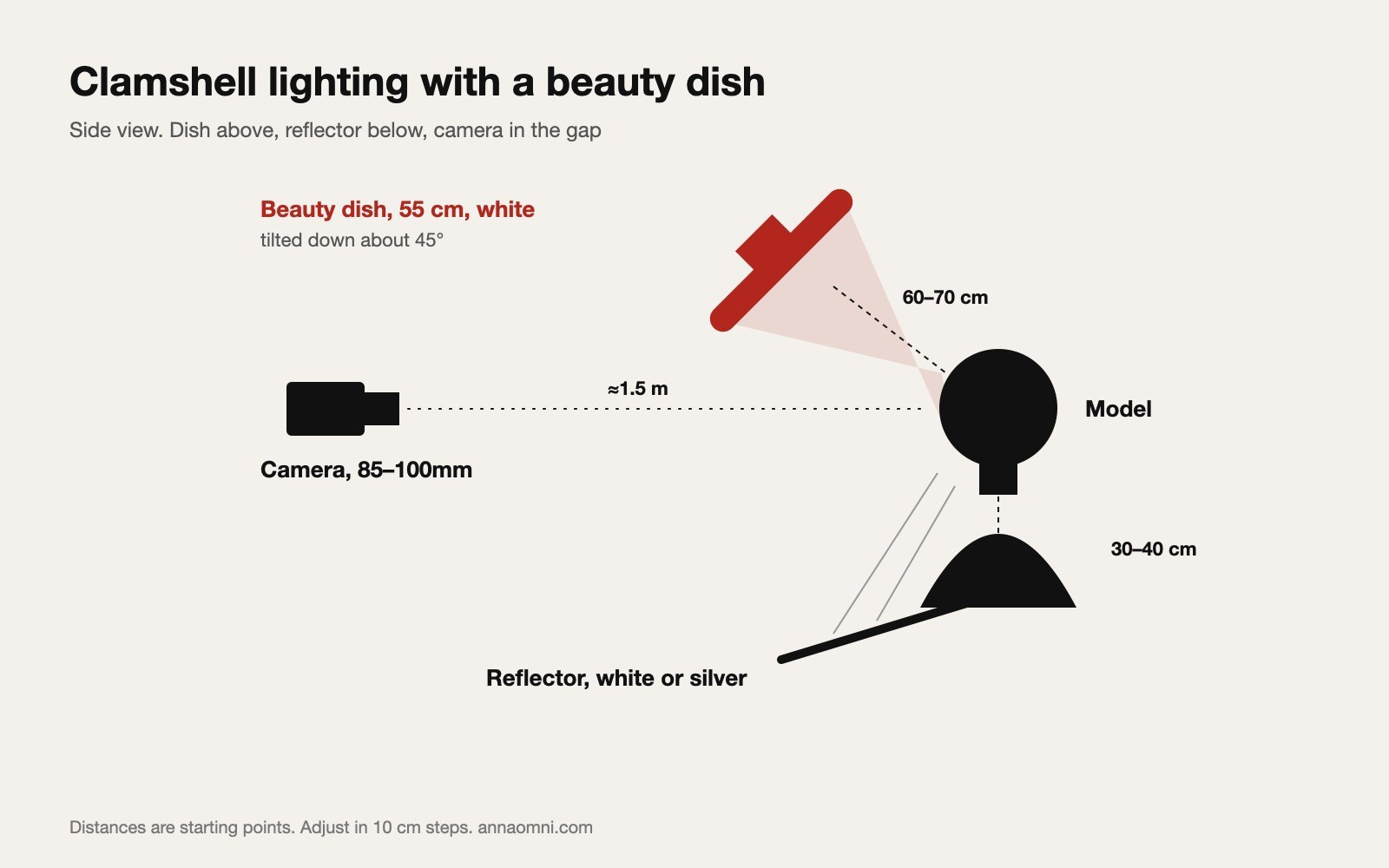
The standard beauty setup. The dish sits above the lens axis, about 60–70 cm from the face, angled down at roughly 45 degrees. A white or silver reflector lies at chest height, 30–40 cm below the chin, and lifts the shadows under the eyes, nose and chin. The camera shoots through the gap between them. A longer lens keeps the camera out of the model’s face; see the guide to lenses for fashion photography for focal lengths and distances.
Silver fill gives more sparkle. White fill is softer.
Large octabox as key for full-length
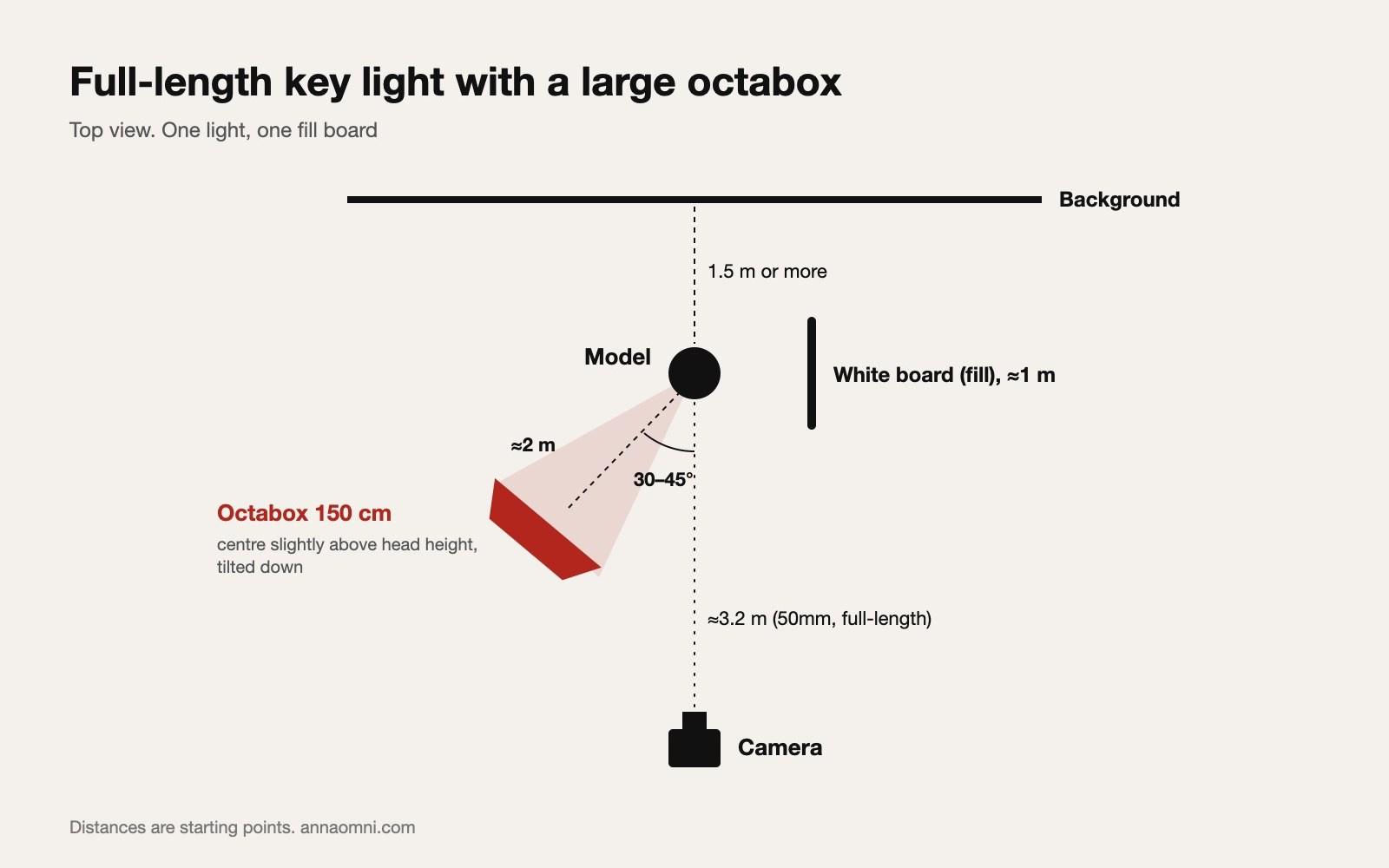
One 150 cm octabox, about 2 m from the model and 30–45 degrees off the camera axis, with its centre a little above head height and tilted down. A white board on the opposite side fills the shadows. Keep the model at least 1.5 m from the background so the shadow falls out of frame.
Which to choose by genre
- Beauty close-ups and make-up: white dish with a clamshell reflector. Add the sock when the skin needs a gentler treatment.
- Fashion, full-length: large octabox. A dish at that distance is hard light, which can be a deliberate editorial look.
- Mature skin: big, close, frontal softbox with fill from below. A bare dish emphasises lines.
- Groups: large octabox or umbrella, further back, so the edges match the centre.
- E-commerce: large softbox or octabox, for consistency from look to look.
Common mistakes
- Dish too far away. At 2–3 m it is a small hard light. Move it in or change modifier.
- Softbox too small for full-length. A 60–80 cm box lights the face and leaves the legs dark, or forces you so far back that the light turns hard.
- No fill with a dish. Deep eye sockets and a dark neck. Add the reflector.
Beauty dish vs octabox, umbrella and ring light
Beauty dish vs octabox. An octabox is a softbox, so everything above applies. Its front gives a rounder catchlight than a rectangular box.
Beauty dish vs umbrella. An umbrella is the fastest and lightest way to make a large source. It throws light everywhere: good for groups, hard to control in a small room. A deep umbrella with a front diffuser behaves much like an octabox. Neither gives the crisp look of a dish.
Beauty dish vs ring light. A ring light sits around the lens. It gives near-shadowless, flat light, a ring-shaped catchlight and, with a ring flash, a thin shadow outline on a close background. It is a distinct look, not an all-round key.
Modifiers worth knowing by brand
A selection by specification, not a test. Check that the mount matches your flash.
- Profoto: Softlight Reflector White, the classic rigid dish at about 52 cm; OCF Beauty Dish White 2', a collapsible version for location; Profoto Softbox 3' Octa and 5' Octa for portraits and full-length.
- Elinchrom: Beauty Dish 44 cm and 70 cm, in white or silver, with interchangeable deflectors; Rotalux Deep Octa 100 cm and Rotalux Octa 135 cm and 175 cm.
- Godox: BDR-W55 (white) and BDR-S55 (silver) for Bowens mount; the collapsible EazyFlow Bty 65 and 85; the QR-P120T parabolic softbox; the R200 ring flash head for the AD200 family.
- Westcott: Beauty Dish Switch by Joel Grimes (24”), collapsible, with interchangeable mounts; Rapid Box Switch 4' Octa.
- Broncolor: Beauty Dish reflector, about 52 cm with a white coating, with an optional honeycomb grid and diffuser.
What to buy first
One modifier. A 100–120 cm octabox with a grid. It handles headshots, half-length and, with some distance, full-length.
Two modifiers. Add a white beauty dish of about 55 cm with a grid and a sock. Now the kit covers beauty work as well.
If you shoot mostly beauty. Reverse the order: dish first, then a large octabox when full-length jobs appear.
FAQ
Softbox vs beauty dish for headshots: which one? A 90–120 cm octabox suits most faces and needs less retouching. Choose a dish for a more sculpted, editorial headshot.
How far should a beauty dish be from the face? Usually 50–90 cm for a 55 cm dish. Further away it becomes a small hard light.
What does a sock do on a beauty dish? It diffuses the light, hides the deflector in the catchlight and softens highlights on skin. Contrast and output drop a little.
Do I need a grid on a beauty dish? Only when you want to keep light off the background or the body. For a clean clamshell portrait it is optional.
What size softbox for full-length portraits? 120–150 cm or larger, placed about 2 m away so the light stays even from head to feet.
Product names and specifications were checked against manufacturers' pages in November 2026. Line-ups change; confirm the current version and the mount before you buy.
Want help choosing lights or planning a shoot? See mentorship or book a consultation.