

Updated November 2026 · Anna Omni, art & fashion photographer and visual creator
The short version: buy the 85mm first. It works in a studio, in a flat and on the street, and it covers headshots, three-quarter and full-length frames. The 135mm is the second lens. It is at its best outdoors and for tight beauty framing, and it needs a lot of room.
The rest of this guide shows the numbers behind that answer: distance, background, blur, weight and close focus. It continues the bigger guide to the best lenses for fashion photography and uses the same distances and lens data.
Working distance: how much room each lens needs
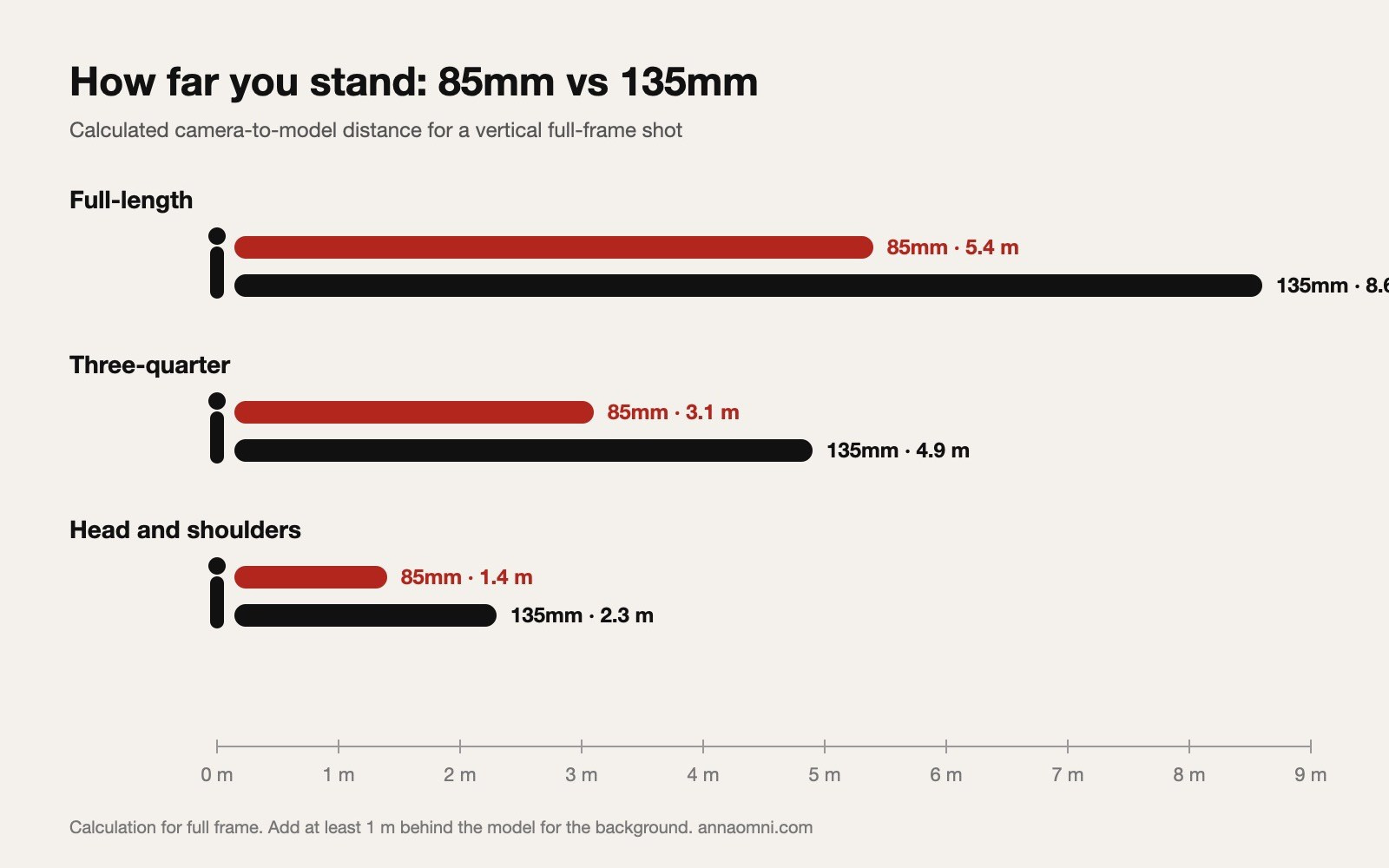
These are calculated distances from camera to model for a vertical full-frame shot. They are a guide, not a measurement.
- Full-length with some air (about 2.3 m of frame height): 85mm — 5.4 m. 135mm — 8.6 m.
- Three-quarter (about 1.3 m): 85mm — 3.1 m. 135mm — 4.9 m.
- Head and shoulders (about 0.6 m): 85mm — 1.4 m. 135mm — 2.3 m.
Add at least a metre behind the model for the background and some space behind you. A full-length shot at 135mm then needs a room about ten metres long. At 85mm it fits in about seven.
So: is 135mm too long for portraits? Indoors, often yes. Outdoors, no.
Perspective, compression and angle of view
Perspective depends on where you stand, not on the lens. Shoot from the same spot with both lenses, crop the 85mm frame, and the proportions of the face are identical.
The difference appears because you move. To keep the same framing with a 135mm you step back. From further away the face looks slightly flatter and the background looks larger. That is what people call compression.
The angle of view is the second difference. Calculated for full frame:
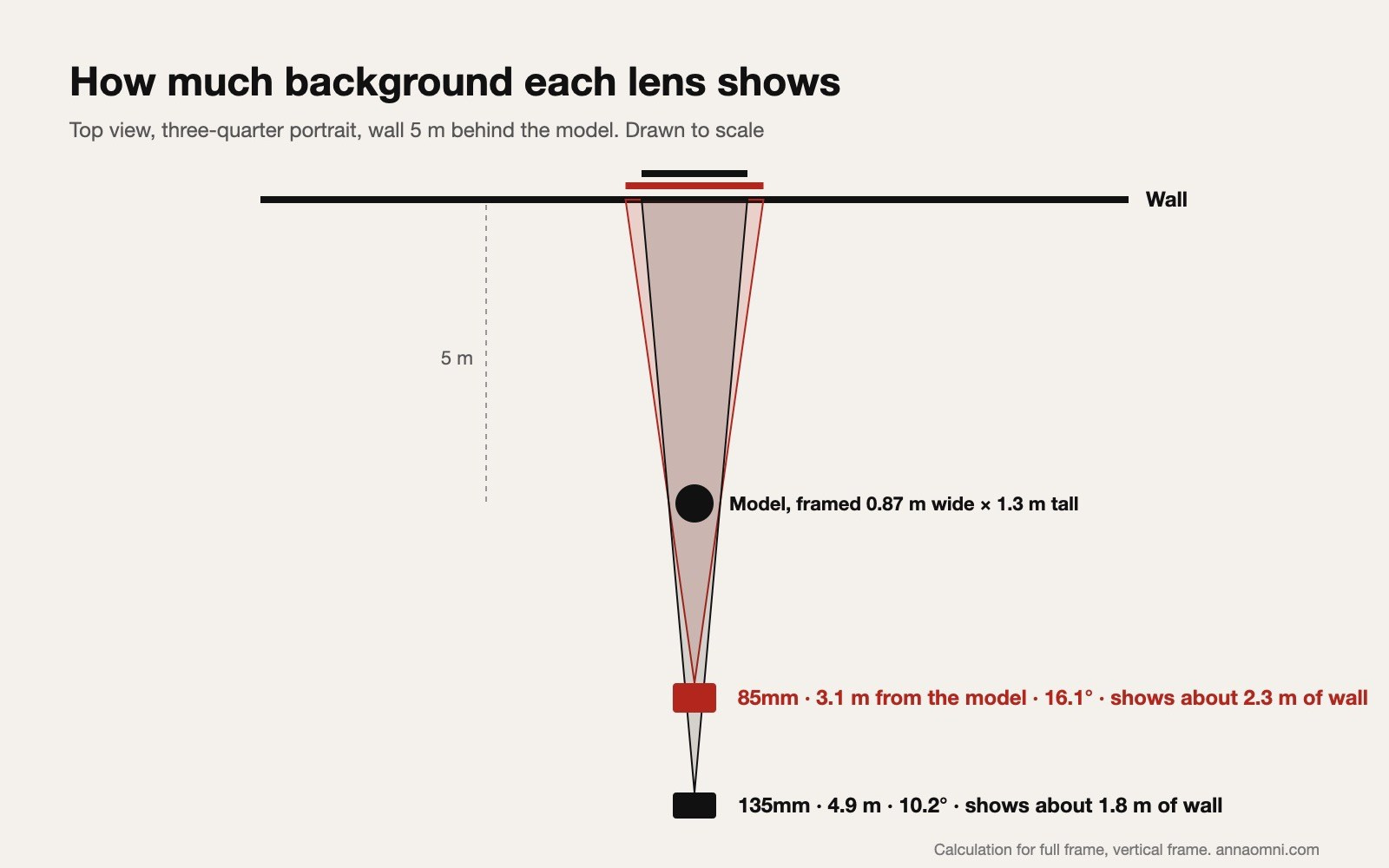
- 85mm: about 28.6° on the diagonal, 16.1° across a vertical frame.
- 135mm: about 18.2° on the diagonal, 10.2° across a vertical frame.
Take a three-quarter shot with a wall 5 m behind the model. By calculation, the 85mm shows about 2.3 m of that wall and the 135mm about 1.8 m. With a more distant background the gap grows, up to about 37% less at 135mm. Outdoors that hides a parked car or a sign next to your clean patch of colour.
85mm vs 135mm bokeh: who blurs the background more
Background blur depends on four things: focal length, aperture, the distance to the model and the distance from the model to the background. Compare lenses at the same framing only.
At the same framing, blur of a far background follows the entrance pupil: focal length divided by f-number. By calculation:
- 85mm f/1.8: about 47 mm.
- 85mm f/1.4: about 61 mm.
- 85mm f/1.2: about 71 mm.
- 135mm f/1.8: 75 mm.
- 135mm f/1.4: about 96 mm.
So for 85mm f/1.4 vs 135mm f/1.8 background blur, the 135mm gives blur discs about 24% larger when the background is far away: trees, a street, city lights. Against an 85mm f/1.2 the gap shrinks to about 6%.
With a close background the result changes. For a three-quarter shot:
- Wall 5 m behind the model: the two lenses give almost the same blur. The calculated difference is about 1%.
- Wall 2 m behind the model: the 85mm f/1.4 blurs about 10% more than the 135mm f/1.8.
The 135mm can still look smoother, because it shows less background and enlarges it. But in a small space it has no blur advantage.
Talking to the model from a distance
At 85mm you direct a three-quarter shot from about three metres. You can speak normally and show a pose with your hands.
At 135mm the same frame puts you about five metres away, and a full-length shot almost nine. On a windy street your voice does not carry. Agree on hand signals, or ask an assistant to stand near the model.
Studio vs location
Studio. The 85mm is the practical choice. On a paper roll there is no background to compress or blur, and with flash at f/8 the extra speed is unused. A 135mm earns its place only for tight beauty frames.
Location. Here the 135mm shows its strengths: a narrow, clean background and strong separation. The 85mm stays more flexible, because it also works in narrow streets and interiors.
Weight, stabilisation and shutter speed
By manufacturers' data, a current 85mm f/1.4 weighs about 630–640 g. A 135mm f/1.8 weighs about 935–995 g, similar to an 85mm f/1.2. A longer lens magnifies camera shake. A common rule of thumb is a shutter speed no slower than one over the focal length: about 1/100 s at 85mm and 1/160 s at 135mm. On high-resolution cameras, go a stop faster.
Stabilisation helps with your shake, not with the model’s movement. Among the 135mm lenses listed here, only the Canon RF 135mm F1.8L IS USM has optical stabilisation, rated by Canon at 5.5 stops. The others rely on the camera’s in-body stabilisation.
Autofocus
Eye detection works well with both focal lengths. The risk is the thin depth of field. At the same framing it depends mostly on the f-number: for head and shoulders it is roughly 2.5 cm at f/1.4 and 3 cm at f/1.8, by calculation. A small sway of the model moves the focus from the eye to the lashes. Use continuous autofocus and check sharpness at 100% during the shoot.
Minimum focus distance and close-ups
This is where the 135mm has a clear advantage for beauty work.
- 85mm: typical minimum focus is 0.75–0.85 m, with a magnification of about 0.11–0.12×. The tightest frame is roughly 30 cm tall: a face with a little air.
- 135mm: the Sony FE 135mm F1.8 GM and Canon RF 135mm F1.8L IS USM focus down to 0.7 m, with 0.25× and 0.26× magnification. The tightest frame is about 14 cm tall: eyes, lips, an earring.
The exception among 85mm lenses is the Canon RF 85mm F2 Macro IS STM, which focuses to 0.35 m and reaches 0.5×. For true macro detail, a 100mm macro is still the right tool.
Which focal length for which job
- 85mm or 135mm for headshots: both work. The 85mm from 1.4 m suits small rooms. The 135mm from 2.3 m gives a slightly flatter face and a cleaner background.
- Three-quarter portraits: 85mm. Three metres is a comfortable distance to direct from.
- 135mm for full body portraits: works outdoors, if you have nine metres and a clear line of sight. Indoors, use the 85mm or a 50mm.
- 85mm vs 135mm for weddings: the 85mm for portraits and small, dim rooms. The 135mm for ceremonies and candid moments from a distance.
- Fashion on location: the 85mm as the main lens, the 135mm for compressed frames with a soft background.
- Beauty: the 135mm, or a 100mm macro.
Current 85mm and 135mm lenses by system
These are current mirrorless lenses, chosen by specifications, not by a lab test.
Sony E-mount
- FE 85mm F1.4 GM II — about 642 g, focuses to 0.85 m.
- FE 135mm F1.8 GM — about 950 g, focuses to 0.7 m.
- FE 85mm F1.8 — the light, budget option.
Canon RF
- RF 85mm F1.4L VCM — about 636 g, focuses to 0.75 m.
- RF 85mm F1.2L USM — about 1,195 g, for the shallowest depth of field.
- RF 135mm F1.8L IS USM — about 935 g, with optical stabilisation.
- RF 85mm F2 Macro IS STM — about 500 g, the budget pick that also does close-ups.
Nikon Z
- NIKKOR Z 85mm f/1.2 S — about 1,160 g, focuses to 0.85 m.
- NIKKOR Z 135mm f/1.8 S Plena — about 995 g, focuses to 0.82 m.
- NIKKOR Z 85mm f/1.8 S — the light option.
Sigma, for Sony E and L-Mount
- Sigma 85mm F1.4 DG DN Art — about 630 g, focuses to 0.85 m.
- Sigma 85mm F1.2 DG Art — about 905 g, light for an f/1.2.
- Sigma 135mm F1.4 DG Art — about 1,430 g, focuses to 1.1 m. The strongest blur here, but heavy, and not a close-up lens.
The alternative: a 70-200mm f/2.8 zoom
A 70-200mm f/2.8 covers both focal lengths. Current versions: Sony FE 70-200mm F2.8 GM OSS II, Canon RF 70-200mm F2.8L IS USM Z (about 1,110 g) and NIKKOR Z 70-200mm f/2.8 VR S II (about 998 g).
The cost is aperture. At 135mm and f/2.8 the entrance pupil is about 48 mm, the same as an 85mm f/1.8. At 200mm it reaches about 71 mm, close to an 85mm f/1.2, but you need even more distance.
Choose the zoom for weddings, events and runway, where you cannot move freely. Choose primes for wider apertures and less weight in the hand.
What to buy if you already own a 50mm or a 24-70mm
- You own a 50mm. Add an 85mm: tighter framing and a more flattering distance. A 135mm leaves a gap in the middle.
- You own a 24-70mm f/2.8. At 70mm you are already close to 85mm. If you mostly shoot outdoors, a 135mm adds more. For shallow depth of field indoors, an 85mm f/1.4 or f/1.8 adds more.
- You own an 85mm. The 135mm is the logical second prime for location and beauty.
- You own nothing in this range. Start with an 85mm f/1.8 or f/1.4.
Checklist before you buy
- Measure your usual space. Less than seven metres of clear floor: 85mm.
- Mostly outdoors with distant backgrounds: 135mm makes sense.
- Mostly studio flash at f/5.6–f/11: a light 85mm f/1.8 is enough.
- Tight beauty frames: 135mm or a 100mm macro.
- Weddings or events: compare both primes with a 70-200mm f/2.8.
- Check the weight, not only the aperture.
- Rent both for a day before you decide.
FAQ
Is 85mm or 135mm better for portraits? The 85mm is the better first lens, because it works in small and large spaces. The 135mm is better for distant backgrounds and tight framing outdoors.
Is 135mm too long for portraits? Not outdoors. Indoors it often is: head and shoulders needs about 2.3 m, a full-length shot about 8.6 m.
Which gives more background blur, 85mm f/1.4 or 135mm f/1.8? At the same framing, the 135mm f/1.8 blurs a distant background about 24% more. With a background a few metres behind the model, the two are about equal.
Is 85mm or 135mm better for headshots? Both are good. Choose the 85mm for small rooms and the 135mm when you have space and want a narrower background.
Is a 70-200mm f/2.8 a replacement for both? For framing, yes. For blur and low light, no: f/2.8 gives less separation than the fast primes.
Specifications were checked against manufacturers' pages in November 2026. Distances, angles and blur figures are calculations for full frame. Lens line-ups change; confirm the current version before you buy.
Want help choosing a kit or planning a shoot? See mentorship or book a consultation.